
How to Structure Calls-to-Action for Maximum Conversion Impact

Most businesses do not have a traffic problem.
They have a decision problem.
Visitors land on their website, scroll, read, and then… do nothing.
The missing link is almost always the same.
Weak, unclear, or poorly structured calls-to-action.
Across Oregon and throughout the United States, businesses lose qualified leads every day because they fail to guide users toward the next step.
A call-to-action is not just a button. It is the turning point between interest and action.
What a Call-to-Action Is Really Responsible For
A call-to-action is not just telling users what to do.
It is removing hesitation.
It bridges the gap between curiosity and commitment.
If your CTA is not clear, compelling, and strategically placed, even highly interested visitors will leave without converting.
This is why CTA structure plays a critical role in overall website performance.
The Biggest CTA Mistake Businesses Make
Most CTAs are generic.
“Contact Us”“Learn More”“Submit”
These phrases are safe.
And that is exactly why they fail.
They do not communicate value. They do not create urgency. They do not tell the user what they gain.
High-converting CTAs are specific, outcome-driven, and aligned with user intent.
Aligning CTAs With User Intent
Not every visitor is ready to take the same action.
Some are just exploring. Others are comparing options. Some are ready to buy.
Your CTA structure should reflect this.
Top-of-funnel users may respond better to softer actions like exploring services or reading guides.
Mid-funnel users may engage with case studies or consultations.
Bottom-of-funnel users are ready for direct actions like booking a call or requesting a quote.
For businesses in Oregon, where local search intent can be highly specific, aligning CTAs with intent significantly improves conversion rates.
The Placement Strategy That Drives Action
Where you place your CTAs matters as much as what they say.
Many websites rely on a single CTA at the bottom of the page.
By then, the opportunity is often lost.
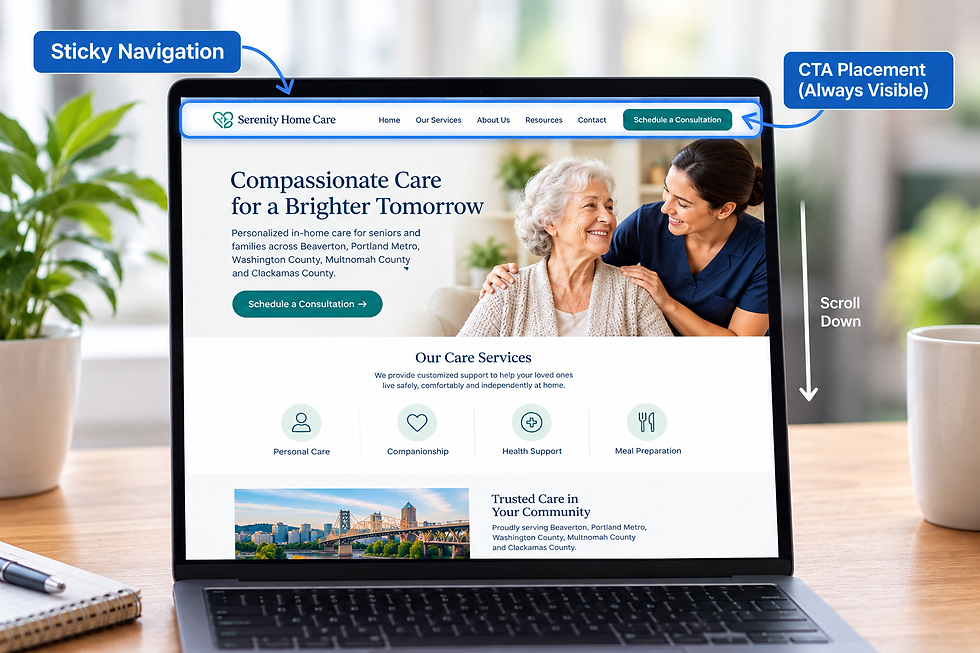
High-performing websites place CTAs strategically throughout the page.
Above the fold for immediate visibilityMid-content for engaged usersEnd of page for decision-ready visitors
This ensures that users always have a clear next step, no matter where they are in their journey.
Designing CTAs for Visibility and Interaction
A CTA should stand out without being disruptive.
It should be visually distinct from the rest of the page.
This includes using contrasting colors, clear typography, and sufficient spacing.
On mobile, buttons should be easy to tap and accessible without excessive scrolling.
For local businesses across the United States, mobile-friendly CTAs are critical, especially for actions like calling or booking.
Writing CTAs That Convert
The wording of your CTA is one of the most important factors in conversion.
Effective CTAs focus on outcomes, not actions.
Instead of telling users what to do, show them what they get.
“Get Your Custom Strategy”“Start Your Growth Plan”“Book Your Free Consultation”
These phrases communicate value and create motivation.
They also reduce uncertainty by making the next step clear.
Reducing Friction at the Point of Action
Even a strong CTA can fail if the process that follows is complicated.
If users click a button and are met with a long form, confusing steps, or unclear instructions, they will abandon the process.
A high-converting CTA is supported by a seamless experience.
Forms should be simple. Processes should be clear.
The goal is to make taking action feel effortless.
Using Multiple CTA Types for Better Results
Not all CTAs need to be the same.
Using a mix of primary and secondary CTAs allows you to capture different types of users.
Primary CTAs focus on high-value actions like booking a call.
Secondary CTAs provide alternative paths, such as downloading a guide or exploring services.
This layered approach ensures that you do not lose users who are not ready for a major commitment.
Leveraging Urgency and Timing
Timing plays a critical role in conversion.
Users are more likely to act when there is a sense of urgency.
This does not mean using aggressive tactics.
It means highlighting the value of acting now.
For example, emphasizing availability, limited capacity, or immediate benefits can encourage action.
When used strategically, urgency increases conversion without damaging trust.
Integrating CTAs Into the User Journey
A call-to-action should not feel like an interruption.
It should feel like a natural next step.
This requires aligning CTAs with the flow of content.
For example, after explaining a service, the CTA should invite the user to take the next logical step, such as scheduling a consultation.
This alignment creates a smoother user experience and increases the likelihood of conversion.
Tracking and Optimizing CTA Performance
CTAs should be continuously tested and optimized.
Small changes in wording, placement, or design can lead to significant improvements.
By analyzing click-through rates and conversion data, businesses can identify what works and refine their approach.
For companies in Oregon and beyond, this data-driven optimization ensures that CTAs remain effective as user behavior evolves.
The Competitive Advantage
Businesses that structure their calls-to-action strategically gain a clear advantage.
They convert more visitors into leads.
They guide users more effectively.
They create smoother, more intuitive experiences.
In competitive markets, this advantage translates directly into growth.
The Bottom Line
A call-to-action is not just a button.
It is the moment where interest becomes opportunity.
If it is not structured correctly, potential leads are lost.
By focusing on clarity, placement, and user intent, businesses can create CTAs that drive real results.
At Yber Digitals, we design conversion systems that guide users toward action and maximize every opportunity.
Schedule a strategy consultation today and discover how to turn your website into a high-performing lead generation engine.
Facebook: https://www.facebook.com/yberdigitals/


Comments