
Designing for Enterprise-Level Sales Cycles: B2B Website Structures That Build Trust

Enterprise sales rarely happen after a single website visit.
A prospective buyer may discover a company through search, review its services, return several times, compare competitors, read case studies, evaluate technical capabilities, consult colleagues, and speak with multiple stakeholders before contacting sales.
That creates a different challenge for B2B websites.
A website designed primarily to generate immediate form submissions may work for a simple purchase decision. It can struggle when the buyer needs substantial evidence before taking the next step.
Enterprise-level websites must support a longer and more complicated decision process.
They need to answer questions at multiple stages, accommodate different stakeholders, demonstrate credibility, explain complex offerings, and provide enough evidence for prospects to justify continuing the conversation.
For B2B companies across the United States, including businesses operating in Oregon, website structure can therefore become a strategic sales asset.
The objective is not simply to make the website look established.
It is to create a digital environment where sophisticated buyers can find the information they need to move forward with confidence.
Enterprise Buyers Need More Than a Strong Homepage
The homepage is important, but it should not be responsible for explaining everything.
Enterprise buyers may need information about:
Products and services
Industries served
Technical capabilities
Implementation processes
Customer outcomes
Security and compliance
Company expertise
Partnerships
Support
Pricing considerations
Leadership
Locations
Resources
Trying to place all of this information on one homepage creates an overloaded experience.
A stronger B2B website uses architecture to distribute information logically.
The homepage establishes positioning.
Service and solution pages explain offerings.
Industry pages demonstrate relevance.
Case studies provide evidence.
Resources support research.
Company pages establish credibility.
Contact and consultation paths support conversion.
Each section has a role in the sales journey.
Structure the Website Around Buyer Questions
Enterprise buyers are not necessarily moving through a simple linear funnel.
Different stakeholders arrive with different questions.
A marketing leader might ask:
"Can this company help us achieve our growth objectives?"
A technology leader may ask:
"Can this solution integrate with our existing systems?"
A financial stakeholder may ask:
"Can we justify the investment?"
An executive may ask:
"Has this company successfully worked with organizations like ours?"
A strong website architecture anticipates these questions.
Instead of organizing the website exclusively around internal departments, businesses should structure information around what buyers need to understand.
This creates a more customer-centered digital experience.
Build Clear Solution Architecture
Complex B2B companies often offer numerous products, services, or capabilities.
The challenge is explaining that complexity without making the website difficult to navigate.
A clear solution architecture can group offerings into logical categories.
For example:
Solutions
Digital Transformation
Data and Analytics
Managed Services
Enterprise Security
Each solution can then have a dedicated page explaining:
The business problem
Who the solution serves
Core capabilities
Implementation approach
Relevant outcomes
Supporting evidence
Related resources
Next steps
This allows prospects to move from broad understanding to detailed evaluation without becoming overwhelmed.
Create Industry-Specific Paths
Enterprise buyers often want to know whether a provider understands their specific environment.
An industry page can demonstrate that understanding.
Instead of simply saying:
"We serve many industries."
A stronger page can discuss the challenges, requirements, and opportunities associated with a particular market.
For example, a technology provider serving healthcare organizations might discuss:
Operational complexity
Data considerations
Integration requirements
Security expectations
Workflow challenges
Regulatory considerations
The exact information depends on the industry.
The strategic principle remains consistent.
Demonstrate relevance before asking for commitment.
For Oregon companies targeting national enterprise accounts, industry-specific architecture can also help expand the website beyond local positioning.
Use Case Studies as Decision Evidence
Enterprise buyers need evidence.
Claims about expertise are less persuasive when they exist without supporting examples.
Case studies can demonstrate:
The customer's original challenge
The solution provided
Implementation complexity
Business outcomes
Technical capabilities
Scope of work
Customer experience
A well-structured case study can help a prospect answer:
"Has this company solved a problem similar to ours?"
That question can be more important than a generic statement about years of experience.
Case studies should also be connected to relevant service and industry pages so prospects can move naturally between proof and solution information.
Design for Multiple Stakeholders
Enterprise purchases often involve committees rather than individual buyers.
That means a website should provide information useful to different audiences without forcing everyone through the same path.
A procurement stakeholder may need business and contractual information.
A technical stakeholder may need specifications and implementation details.
An executive may want strategic outcomes.
An operational stakeholder may care about process and support.
The website should make these resources discoverable.
This does not require creating dozens of audience pages.
It requires thoughtful content organization and internal linking.
Build a Strong Resource Center
Enterprise buyers often conduct extensive research before engaging sales.
A resource center can support that process.
Useful content may include:
Research reports
White papers
Industry guides
Technical documentation
Case studies
Webinars
Articles
Comparison resources
Implementation guides
FAQs
The resource center should not become a content archive where everything is simply published chronologically.
Organize resources by topic, audience, industry, or business problem.
This allows buyers to find the information most relevant to their current stage.
Make Technical Information Accessible
Technical credibility matters in enterprise sales.
However, technical information should be presented in a way that serves both technical and nontechnical stakeholders.
A page can provide a concise business-level explanation first, followed by deeper technical details.
For example:
Business Value
Improve operational visibility and reduce manual reporting.
Technical Capabilities
Integration support, data architecture, reporting infrastructure, and API connectivity.
This layered approach allows different stakeholders to find appropriate levels of detail without creating separate websites for every audience.
Trust Requires More Than Testimonials
Enterprise trust is built through multiple signals.
A sophisticated B2B website may need to demonstrate:
Relevant experience
Customer results
Leadership expertise
Industry recognition
Certifications
Partnerships
Security practices
Clear company information
Transparent processes
Professional content
No single trust signal is sufficient.
A prospect should be able to investigate the company from multiple angles and consistently encounter evidence of competence.
Make the Company Easy to Evaluate
Enterprise buyers often research the company itself, not just its services.
A strong About section can communicate:
Company history
Leadership
Expertise
Locations
Mission
Industry experience
Organizational capabilities
Leadership pages can be particularly valuable for complex services where the expertise of the people delivering the work matters.
The goal is not to create corporate biography pages filled with generic statements.
The goal is to make the organization easier to understand and evaluate.
Create Conversion Paths for Different Readiness Levels
Not every enterprise visitor is ready to "Contact Sales."
That CTA may be too aggressive for someone conducting initial research.
A stronger website can offer different next steps.
For example:
Early research
Explore industry resources.
Active evaluation
Review case studies.
Solution consideration
Explore implementation details.
Sales ready
Schedule a consultation.
This gives prospects control over their journey.
It also allows the website to capture interest before the buyer reaches the final decision stage.
Do Not Hide the Conversion Path
While enterprise buyers need information, they should not have to search for the next step.
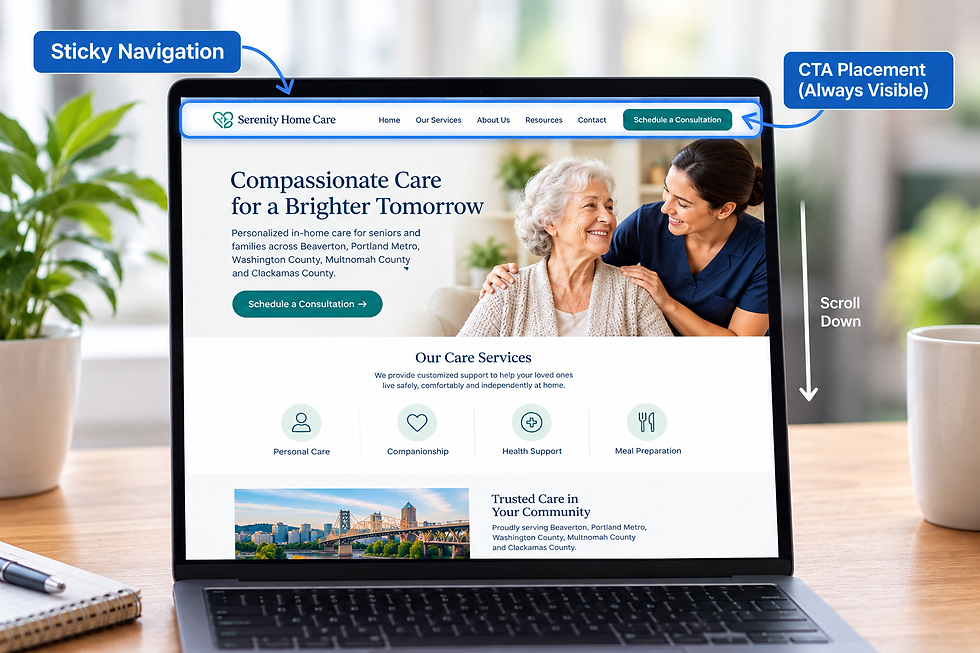
Calls to action should remain visible and relevant throughout the website.
Examples include:
Schedule a Consultation
Talk With an Expert
Request a Demo
Discuss Your Requirements
Explore the Solution
The CTA should match the page.
A technical documentation page may benefit from "Talk With an Expert."
A case study may use "Discuss a Similar Project."
A solution page may use "Request a Consultation."
Context improves relevance.
Enterprise UX Requires Strong Search and Navigation
Large B2B websites can contain hundreds or thousands of pages.
Navigation alone may not be enough.
Site search can help returning users locate specific information quickly.
Search functionality should ideally support:
Relevant results
Clear result titles
Useful descriptions
Logical filtering
Mobile usability
Navigation should also reflect the site's information architecture rather than internal company terminology that customers may not understand.
A business may call something "Integrated Growth Architecture" internally.
Customers may search for "marketing automation."
Use language customers understand.
Website Performance Still Matters
Enterprise websites sometimes become heavy because of complex integrations, animations, tracking systems, videos, and third-party tools.
Complexity should not become an excuse for poor performance.
Slow pages create friction at every stage of the buying journey.
Performance should be considered alongside:
Mobile usability
Core web experience
Accessibility
Image optimization
Script management
Hosting infrastructure
Technical architecture
Enterprise positioning requires enterprise-level digital execution.
A sophisticated buyer may question operational discipline if the company's own website feels difficult to use.
Align the Website With Sales Operations
A B2B website should not operate independently from the sales organization.
Marketing and sales teams should understand:
Which pages prospects visit
Which resources influence conversations
Which case studies support objections
Which conversion paths generate qualified leads
Which content helps sales move opportunities forward
CRM and analytics data can help connect website behavior with pipeline activity.
The objective is to understand not only which pages receive traffic, but which digital experiences contribute to revenue.
Design for Long Consideration Periods
Enterprise prospects may return to a website repeatedly.
That means the site should support continued research.
A returning visitor should be able to move deeper into the information architecture rather than seeing the same introductory messaging every time.
Strong internal linking can help prospects progress:
Industry Page → Solution Page → Case Study → Resource → Consultation
This creates a connected research journey.
The website becomes a self-service sales environment that supports buyers before and during conversations with the sales team.
Local Roots Can Support National Enterprise Positioning
A business does not need to abandon its Oregon identity to compete for larger accounts.
A company can communicate local expertise while demonstrating national capabilities.
For example, an Oregon-based B2B provider can present:
Regional experience
National customer relationships
Industry expertise
Specialized capabilities
Scalable delivery processes
The website should make the company's actual market position clear.
Local credibility and national ambition do not have to conflict when the architecture communicates both appropriately.
Measure Website Performance Against the Sales Cycle
Traditional website metrics are useful, but enterprise websites require deeper measurement.
Businesses should consider:
Qualified lead generation
Consultation requests
Demo requests
Resource engagement
Case study engagement
Returning visitor behavior
Assisted conversions
Pipeline influenced by website interactions
Sales cycle progression
A page that generates few direct leads may still influence significant revenue if prospects repeatedly use it during evaluation.
This is why B2B website measurement should extend beyond last-click attribution.
The Website Should Become Part of the Sales Team
The best enterprise B2B websites answer questions before sales representatives have to answer them.
They demonstrate capabilities.
They establish credibility.
They provide evidence.
They explain complex solutions.
They address objections.
They support different stakeholders.
They make the next step clear.
That does not replace sales.
It makes sales conversations more productive.
When prospects arrive with a stronger understanding of the business, sales teams can spend less time explaining basic capabilities and more time discussing the customer's actual needs.
Final Takeaway
Enterprise-level sales require more than an attractive B2B website.
They require an information architecture designed around how complex buyers research, evaluate, compare, and justify decisions.
A strong structure connects solutions, industries, case studies, resources, technical information, company expertise, and conversion paths into one coherent experience.
The goal is not to force enterprise prospects into a short conversion funnel.
It is to give them enough clarity and evidence to confidently move through a longer decision process.
For B2B businesses across the United States, including Oregon companies pursuing larger markets, this can turn the website from a digital brochure into a genuine sales enablement platform.
Ready to build a B2B website that supports complex sales cycles and enterprise-level buyers?
Schedule a strategy consultation with Yber Digitals to evaluate your website architecture, buyer journey, content structure, trust signals, and conversion paths, then develop a digital experience built to support longer sales cycles and stronger business growth.
Facebook: https://www.facebook.com/yberdigitals/


Comments