
Conversion Architecture: Designing Websites That Pre-Sell Before the First Click

Most websites are built to look good.
Very few are built to convert.
They have clean layouts, modern visuals, and all the expected sections. But when it comes to turning visitors into leads, they fall short.
The reason is simple. Design without strategy does not sell.
Conversion architecture changes that.
It is not about aesthetics. It is about engineering a website that positions your business so effectively that by the time a visitor engages, they are already convinced.
For service-based businesses in Oregon and across the United States, this is how a website stops being a digital brochure and becomes a revenue-generating asset.
What Is Conversion Architecture
Conversion architecture is the strategic structuring of your website to guide users toward a specific action, using intentional design, messaging, and user flow.
It focuses on pre-selling.
Instead of waiting for a visitor to explore and decide, the website immediately communicates value, builds trust, and reduces hesitation.
Every section, element, and interaction has a purpose.
Nothing is random.
Core components of conversion architecture include:
Clear positioning and value proposition
Strategic layout that guides user attention
Trust signals that eliminate doubt
Conversion pathways that are easy to follow
This is what separates high-performing websites from average ones.
The First Impression Happens Before the Scroll
Users form an opinion about your website within seconds.
If your message is unclear or generic, they leave.
This is where most websites lose potential customers.
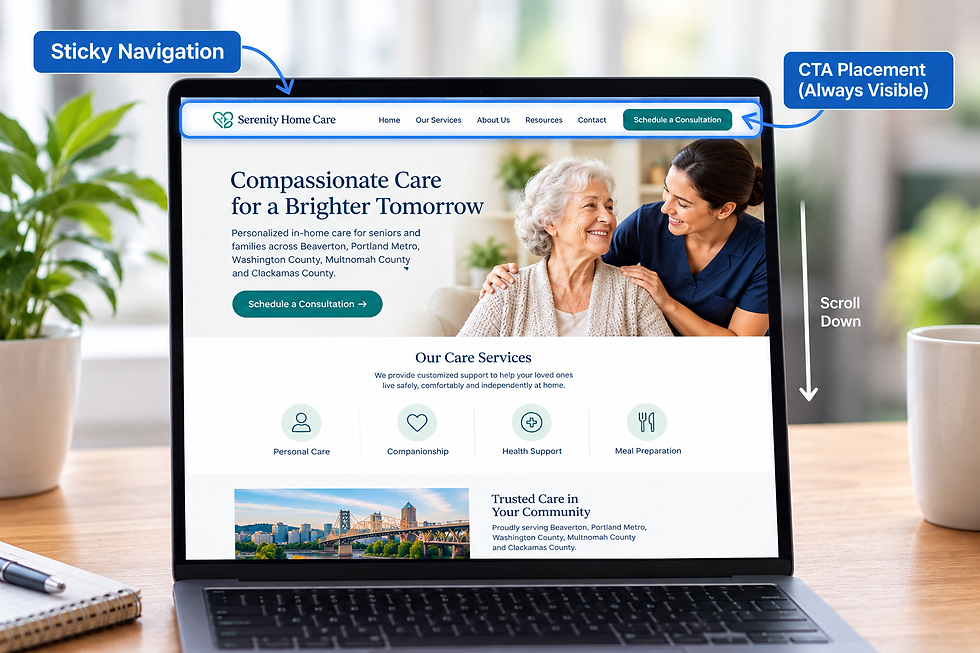
The top section of your website, often called the above-the-fold area, is your most valuable real estate.
It determines whether a visitor stays or exits.
A high-converting above-the-fold section should include:
A clear and specific headline that communicates what you do
A supporting message that highlights the outcome or benefit
A visible call to action that tells users what to do next
For example, a service business in Oregon should not say “We provide quality services.” That is meaningless.
It should communicate a clear result, such as generating leads, increasing revenue, or solving a specific problem.
Clarity converts.
Positioning That Pre-Sells Your Service
Visitors are not just evaluating your services. They are evaluating whether you are the right choice.
Your website must answer that immediately.
Strong positioning differentiates your business from competitors and sets expectations.
Effective positioning communicates:
Who you help
What specific problem you solve
Why your approach is different or better
For businesses operating across the U.S., this is critical.
You are not just competing locally. You are competing nationally.
Your messaging must reflect authority and confidence.
When positioning is clear, visitors do not need to guess. They understand your value instantly.
Designing the User Journey for Conversion
A high-converting website is not a collection of pages. It is a guided journey.
Every section should move the user closer to a decision.
A well-structured user journey includes:
Initial clarity and engagement at the top of the page
Supporting sections that build credibility and explain the process
Conversion points placed strategically throughout the page
Most websites place a single call to action at the top and bottom.
That is not enough.
Users need multiple opportunities to take action as their confidence increases.
For example, after presenting your services, you should immediately provide a way to contact or schedule.
Momentum matters.
Using Trust Signals to Remove Friction
Trust is one of the biggest factors in conversion.
If users are unsure about your credibility, they hesitate.
If they hesitate, they leave.
Your website must eliminate doubt before it appears.
Strong trust signals include:
Client testimonials and reviews
Case studies or proven results
Clear business information and credentials
For service businesses in Oregon and across the United States, trust signals are especially important in competitive markets.
They provide reassurance and validate your claims.
Without them, even the best messaging can fail.
Content That Sells Without Feeling Like Sales
Conversion-focused websites do not rely on aggressive sales tactics.
They use strategic content to guide decisions.
Every section should answer a question or address a concern.
High-converting content should:
Focus on outcomes rather than features
Address common objections before they arise
Use clear, concise language that is easy to understand
For example, instead of listing services, explain how those services impact the client’s business.
This shifts the focus from what you do to what they gain.
That is what drives action.
The Role of Visual Hierarchy in Conversion
Design is not just about appearance. It is about guiding attention.
Visual hierarchy determines what users see first, second, and third.
If everything looks equally important, nothing stands out.
Effective visual hierarchy includes:
Clear contrast between headings, text, and calls to action
Strategic use of spacing to improve readability
Design elements that direct focus toward key actions
This ensures that users naturally follow the path you have designed.
For businesses across the U.S., where attention spans are short and competition is high, this level of clarity is essential.
Conversion Pathways That Reduce Effort
The easier it is to take action, the more likely users are to convert.
Complex forms, unclear steps, or unnecessary friction reduce conversions.
Your website should make the next step obvious and effortless.
A strong conversion pathway includes:
Simple and intuitive contact forms
Clear calls to action that are easy to find
Multiple ways for users to engage, such as calls, forms, or booking options
For example, a service business in Oregon should provide immediate ways to connect, whether through a phone number, form, or scheduling tool.
Convenience drives action.
Aligning SEO With Conversion Architecture
SEO brings users to your website. Conversion architecture turns them into clients.
These two systems must work together.
A common mistake is focusing on rankings without considering what happens after the click.
To align SEO with conversion architecture:
Ensure landing pages match the intent of the keyword
Design pages that address the specific needs of the visitor
Guide users toward relevant actions based on their intent
For example, a user searching for “web design services Oregon” expects a service-focused page, not a general blog.
Matching intent increases both engagement and conversion rates.
Measuring Conversion Performance
A well-designed website should produce measurable results.
If it is not converting, it is not working.
Key metrics to track include:
Conversion rate across key pages
Lead volume and quality
User behavior and engagement patterns
These insights allow you to refine your strategy and improve performance over time.
For businesses across the United States, this is how websites evolve from static assets into dynamic growth tools.
Common Mistakes That Kill Conversions
Even visually appealing websites can underperform due to strategic gaps.
Common mistakes include:
Generic messaging that lacks clarity and differentiation
Weak or hidden calls to action
Overly complex navigation or user flow
Lack of trust signals or credibility indicators
These issues create friction and reduce the likelihood of conversion.
Fixing them often leads to immediate improvements.
Why Conversion Architecture Is Non-Negotiable
In today’s digital landscape, traffic alone is not enough.
You need a system that turns visitors into clients consistently.
Conversion architecture provides that system.
It ensures that every visitor interaction is intentional, every message is clear, and every pathway leads to action.
For service-based businesses in Oregon and across the United States, this is the difference between a website that exists and a website that performs.
If your current website is not generating the results you expect, the issue is not just design. It is strategy.
Schedule a strategy consultation with Yber Digitals and build a website engineered to pre-sell, convert, and scale your business.
Facebook: https://www.facebook.com/yberdigitals


Comments